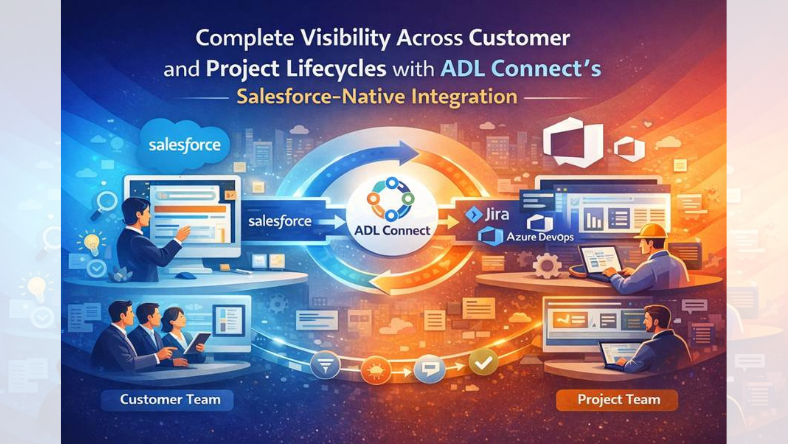
Complete Customer & Project Visibility with ADL Connect on Salesforce

Complete Customer & Project Visibility with ADL Connect on Salesforce

Last updated on August 19, 2026

Author : ADL Solution

Salesforce-native  ·  Full Lifecycle Visibility
A customer request leaving the account team and disappearing into a delivery tool with no visible status

A request leaves your customer-facing team and vanishes into delivery. Days pass, the customer asks for an update, and nobody can answer without chasing three people across two systems. That blind spot between the promise and the work is where trust quietly erodes.

It starts innocently. A client logs a request — a fix, a feature, an onboarding task — and your account manager promises to keep them posted. The request is captured in Salesforce, then handed to a delivery team that lives in Jira or Azure DevOps. From that handoff onward, the two records drift apart, each telling only half the story.

A week later the client emails: ‘Any progress?’ The account manager doesn’t know. They ping a project lead, wait, forward a vague answer, and hope it holds. Repeat that across every open request and you have a business running on secondhand information — and customers who can feel it.

Problem one

Progress Trapped in Someone Else’s Tool

The moment a request crosses into delivery, its status lives somewhere your customer-facing teams can’t see. Salesforce shows the case was escalated; it doesn’t show that the work is in code review, blocked on a dependency, or shipping Friday. The people talking to the customer are working from a snapshot that went stale the instant they saved it.

So the details get carried by hand — a status pasted into a note, a due date typed into a field, a comment relayed in a meeting. Every manual hop is a chance for information to arrive late, arrive wrong, or never arrive at all. The record looks current; it rarely is.

Delivery status being copied by hand from a project tool into a Salesforce record
A customer journey split across separate Salesforce, Jira and Azure DevOps systems with no shared view
Problem two

One Journey, Fragmented Across Systems

A single customer journey rarely stays in one place. It begins as a lead or a case in Salesforce, becomes a work item in Jira or Azure DevOps, moves through sprints and releases, and ends back with the customer. Each stage is recorded faithfully — just in a different system, owned by a different team, invisible to the others.

No one holds the whole thread. Support can’t see engineering’s progress; delivery can’t see the customer’s follow-ups; leadership can’t answer ‘how are we actually doing?’ without a hand-built spreadsheet. There is no single source of truth — only fragments nobody fully trusts.

The cost of the black hole

What Poor Visibility Really Costs

On their own these feel like normal friction. Across a quarter, they decide how quickly and confidently your teams can move.

Blind account teams

Nobody can answer ‘where is my request?’ without interrupting the delivery team.

The status-meeting tax

Standing calls and Friday check-ins exist only to shuttle information between tools.

Fragmented history

Comments, decisions, and attachments scatter across whichever system they started in.

Manual reporting

Rollups get rebuilt by hand in spreadsheets that are outdated before the meeting ends.

Slow, shaky decisions

Leaders act on secondhand status, so risks surface late and priorities lag reality.

Weighing your options

Three Ways Teams Try to Reconnect the Lifecycle

Once the blind spot becomes impossible to ignore, most teams weigh one of three paths. The first is to build the link in-house, asking developers to wire the systems together with custom code. It fits your process exactly — and then becomes a permanent maintenance job that competes with the roadmap every time an API changes.

The second is to route updates through a general integration platform, a middleware layer that shuttles data between tools on a schedule. It is flexible, but it adds another product to license and secure, and your customer data now travels through a third party outside your walls.

The third is to install a purpose-built app that already understands both worlds and runs where your customer data already lives. Done right, it skips the upkeep of custom code and the overhead of middleware — and this is where the real question of visibility finally gets answered.

Three ways to reconnect the lifecycle: build in-house, use a middleware platform, or install a purpose-built app
ADL Connect giving one connected view across Salesforce, Jira and Azure DevOps
A better fit

Where ADL Connect Changes the Picture

That third path is where ADL Connect lives — a purpose-built, Salesforce-native app from the AppExchange, engineered to erase the compromises the other two approaches leave behind. There is no middleware to stand up and no custom codebase to maintain.

Installed directly inside Salesforce, it links each record to its Jira issue or Azure DevOps work item and keeps them in step in real time. Fields, statuses, comments, and attachments flow both ways automatically, so a customer request and the work behind it finally share one continuous, visible thread — from first contact to final resolution.

How it compares

ADL Connect Against the Alternatives

The same goal — end-to-end visibility — measured against what actually decides whether it lasts past the first quarter.

What mattersIn-house buildMiddleware platformADL Connect Best fit
Time to visibilityDrawbackWeeks of development before a single record links.Trade-offLengthy setup and field mapping before data flows.SeamlessManaged-package install — connected the same day.
How fresh the data isDrawbackOnly as current as your last scheduled job.Trade-offOften batch syncs on a timed interval.SeamlessReal-time updates, both directions.
Where data livesDrawbackSpread across custom scripts and servers.Trade-offPasses through a third-party platform.SeamlessStays inside your Salesforce org.
TraceabilityDrawbackWhatever you find time to log.Trade-offFields only, history left behind.SeamlessStatus, comments & files, request to resolution.
UpkeepDrawbackYour team owns every API change forever.Trade-offA dedicated admin babysits the flows.SeamlessMaintained for you, updated each release.
Total costDrawbackA hidden engineering salary line.Trade-offLicences that grow with volume.SeamlessFlat pricing with a free tier.
Live delivery status and history from Jira and Azure DevOps shown on a Salesforce record
The payoff

The Whole Lifecycle, Visible in Salesforce

Once connected, delivery progress appears right on the Salesforce record your teams already use. No new tool to learn, no login to chase — the answer to ‘where is this?’ is simply on screen, current, and shared by everyone who needs it.

  • See live status and progress without leaving the record
  • Read and post updates that sync straight to the delivery team
  • Trace every request from first contact to final resolution
  • Give leadership real-time rollups instead of manual spreadsheets
  • Answer customer questions with confidence, not guesswork
Why it works

Visibility Your Whole Organization Can Trust

Beyond the daily convenience, ADL Connect is built to satisfy the people who depend on the numbers.

Faster decisions

Real-time status means risks surface early, while there’s still time to act on them.

Clear accountability

Every record links to its work item, so ownership of the next step is never ambiguous.

End-to-end traceability

Follow any request from Salesforce through delivery and back, one step at a time.

Always current

Bidirectional sync keeps both sides live, so no team ever works from stale data.

Customer feedback

What Changes When Everyone Can See

A few words from the leaders who gave their teams one connected view of every request.

★★★★★

“My team used to open a ticket somewhere else just to check status. Now delivery progress sits right on the account record — our renewal conversations finally start from facts, not guesses.”

OS
Olivia S.Customer Success Director, SaaS
★★★★★

“For the first time I can trace a request from the customer all the way to the work item without exporting anything. Our status meetings got shorter because nobody needs them just to find out what’s happening.”

IQ
Ibrahim Q.PMO Lead, Energy
★★★★★

“The real-time sync means my agents answer ‘when will this be done?’ on the first call. That one change did more for our CSAT than any script we’d ever tried.”

NV
Nina V.Service Ops Manager, Travel
Pricing

Complete Visibility, Starting at Zero

Prove the value on a real project at no cost, then scale on a flat rate — not a bill that climbs every time volume does.

PlanPriceKey inclusions
StartupFree forever$0 Up to 5 users, 1,000 monthly callouts, the native AppExchange package, and business-hours email support — enough to connect your first lifecycle end to end.
EnterpriseMost popular$49 / monthUnlimited users and callouts, 24×7 priority support with a rapid response window, and a dedicated success manager.
FAQ

Questions Buyers Ask About Visibility

Can business users see delivery status without a Jira or Azure DevOps licence?

Yes. Linked status, comments, and attachments appear inside Salesforce, so account, support, and success teams get full visibility without a separate licence or a second login.

How current is the information they see?

Updates sync in real time in both directions, so the Salesforce record always reflects the latest delivery status — no scheduled jobs and no manual refresh.

Does it give visibility across both Jira and Azure DevOps?

Yes. ADL Connect links Salesforce records to Jira issues or Azure DevOps work items, so even a mixed-tool delivery organization gets one continuous view.

Will connecting the systems expose our customer data to a third party?

No. The app runs inside your Salesforce org using Named Credentials and OAuth and respects field-level security, so data never leaves your security boundary.

How quickly can we get this level of visibility live?

Most teams are running in under an hour: install the managed package, authorise the connection, and map the records and fields you want to see.

Close the Gap Between Promise and Progress

Complete visibility isn’t about moving more data — it’s about giving every team one trustworthy view of where each request stands, without chasing, guessing, or rekeying. Real-time, bidirectional, Salesforce-native sync is what turns a fragmented lifecycle into a single traceable thread.

If your teams still lose sight of a request the moment it enters delivery, that blind spot is costing you today. ADL Connect is the fastest, lowest-risk way to make the whole journey visible — from request to resolution.

Explore ADL Connect →

Recent Blogs

The Complete Guide to Salesforce Jira Integration in 2026

10 Reasons to Connect Salesforce with Jira in 2026

Why ADL connect is best  Jira connector in market

Why ADL Connect is best azure devops connector in market