
In today’s digital-first organizations, collaboration between business teams and IT teams is no longer optional it is critical. Sales, service, and support teams typically manage customer interactions in Salesforce, while engineering and delivery teams rely on Jira or Azure DevOps to track development work. When these systems operate in silos, organizations face familiar challenges: duplicated effort, miscommunication, delayed resolutions, and limited visibility into progress.
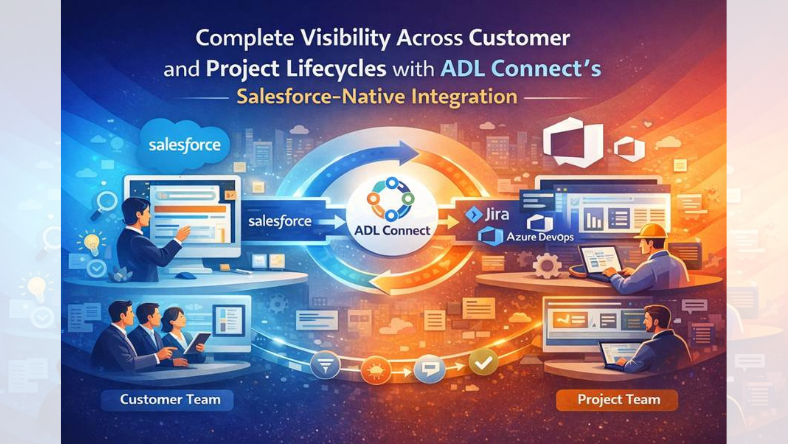
For Seamless IT–Business Collaboration
ADL Connect is designed to solve this exact problem by creating a unified, real-time bridge between Salesforce, Jira, and Azure DevOps, enabling true IT–business collaboration without forcing teams to abandon their preferred tools.
Breaking Down the Silos Between Business and IT
Traditionally, business users log issues in Salesforce and then manually relay details to engineering teams via emails, meetings, or spreadsheets. Updates from Jira or Azure DevOps are often shared informally, leading to outdated information in Salesforce and frustrated stakeholders.
ADL Connect eliminates this disconnect by enabling bidirectional synchronization. Once a Salesforce record is linked to a Jira issue or Azure DevOps work item, updates flow automatically between systems. Status changes, field updates, comments, attachments, and assignments stay in sync, ensuring everyone works with the same, up-to-date information.
Rule-Based Integration with Full Control
One of the key differentiators of ADL Connect is its rule-based architecture. Administrators can configure outbound and inbound rules that define exactly how and when data should be synchronized. Project mappings act as a controlled contract between Salesforce objects and external work items, ensuring that data alignment is precise and governed.
This approach provides flexibility for different teams and use cases such as support-driven bug tracking, customer-requested enhancements, or internal delivery workflows while maintaining security, data integrity, and compliance.
Collaboration Without Context Switching
ADL Connect brings engineering context directly into Salesforce. Business users can view linked Jira or Azure DevOps items, including comments and attachments, without leaving Salesforce. Likewise, engineering teams continue to work in Jira or Azure DevOps without needing direct access to Salesforce.
By reducing context switching, ADL Connect improves productivity on both sides. Conversations become clearer, follow-ups decrease, and accountability improves because everyone can see the full lifecycle of a request from customer need to technical resolution.
End-to-End Visibility Across the Lifecycle
With ADL Connect, organizations gain end-to-end traceability. A customer issue raised in Salesforce can be tracked all the way through development and resolution in Jira or Azure DevOps, and back again. This visibility empowers managers and stakeholders with accurate insights into progress, bottlenecks, and delivery timelines.
Enabling Faster, Smarter Outcomes
By unifying Salesforce with Jira and Azure DevOps, ADL Connect transforms fragmented workflows into a cohesive collaboration model. Business and IT teams stay aligned, response times improve, and manual coordination is replaced with automation and transparency.
For organizations looking to scale efficiently while maintaining strong alignment between customer needs and technical execution, ADL Connect provides a practical, enterprise-ready foundation for seamless IT–business collaboration.