
As enterprises scale their digital initiatives, aligning business operations with engineering execution becomes a strategic necessity rather than a technical convenience. Salesforce is widely adopted as the system of record for sales, service, and customer engagement, while Azure DevOps powers planning, development, and delivery for engineering teams. The challenge lies not in using these platforms independently, but in connecting them effectively without compromising governance, visibility, or productivity.
This is where ADL Connect stands out as the most robust, flexible, and enterprise-ready Azure DevOps connector available in the market today.
The Real Problem with Most Azure DevOps Connectors
Many Azure DevOps connectors promise “integration” but deliver only surface-level synchronization. Common limitations include:
- One-way data sync with limited update support
- Rigid mappings that break when processes evolve
- Heavy dependency on middleware or external platforms
- Poor Salesforce user experience
- Limited visibility into Azure DevOps artifacts
- Weak error handling and auditability
As a result, organizations often end up with brittle integrations that require constant maintenance and still fail to deliver true IT–business alignment.
ADL Connect was built specifically to overcome these limitations.
Salesforce-Native by Design, Not by Claim
One of the most critical differentiators of ADL Connect is that it is Salesforce-native. Unlike connectors that rely heavily on external middleware or custom scripts, ADL Connect is designed to live and operate within the Salesforce ecosystem.
This means:
- Native Salesforce UI components
- Standard permission and profile-based access control
- Seamless AppExchange installation and upgrades
- No disruption to existing Salesforce governance models
For business users, this translates into a familiar, intuitive experience. For administrators, it means lower operational risk and easier long-term maintenance.
True Bidirectional Synchronization with Azure DevOps
ADL Connect delivers true bidirectional synchronization, not just record creation or partial updates.
It supports:
- Field-level updates in both directions
- Status and state transitions
- Comments and discussion threads
- Attachments and files
- Ownership and assignment changes
Once a Salesforce record is linked to an Azure DevOps work item, both systems remain in sync throughout the lifecycle. This ensures that Salesforce always reflects the current engineering reality, and Azure DevOps always retains the necessary business context.
Rule-Based Architecture That Scales with the Enterprise
What truly elevates ADL Connect above competitors is its rule-based integration architecture.
Instead of hardcoded logic, ADL Connect allows administrators to define:
- Outbound rules (Salesforce → Azure DevOps)
- Inbound rules (Azure DevOps → Salesforce)
- Project mappings between objects and work item types
- Controlled sync directions per field
- Conditional logic based on business requirements
This approach provides flexibility without sacrificing control. As processes evolve, integrations can be adjusted through configuration rather than redevelopment an essential requirement for enterprise-scale deployments.
Deep Azure DevOps Visibility Inside Salesforce
Most connectors stop at syncing data. ADL Connect goes further by bringing Azure DevOps context directly into Salesforce.
Salesforce users can:
- View linked Azure DevOps work items
- Track current status and progress
- Read comments and updates
- Access and preview attachments
All of this happens without leaving Salesforce or requiring Azure DevOps licenses for non-technical users. This dramatically reduces context switching and improves collaboration between business and engineering teams.
End-to-End Traceability Across Customer and Delivery Lifecycles
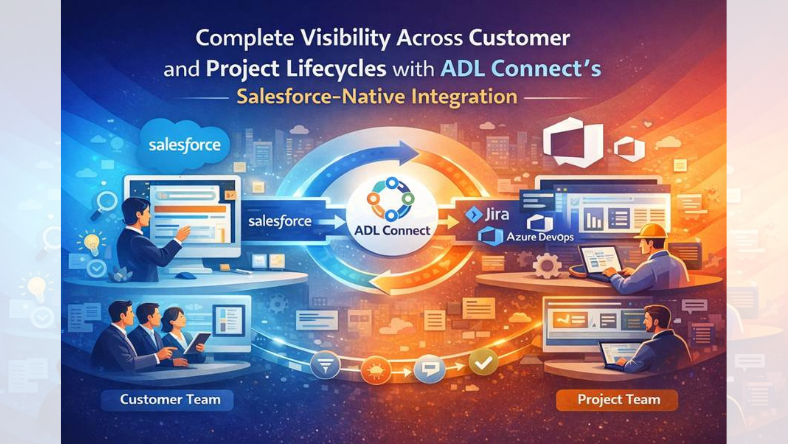
ADL Connect enables full end-to-end traceability, linking customer-facing records to delivery execution.
For example:
- A customer request logged in Salesforce
- Converted into an Azure DevOps work item
- Tracked through development and release
- Synced back to Salesforce upon completion
This traceability supports:
- Accurate reporting and analytics
- Strong accountability across teams
- Audit readiness for regulated industries
- Better customer communication and expectation management
Few connectors in the market offer this level of lifecycle continuity.
Enterprise-Grade Security and Compliance
Security is often an afterthought in integration tools. ADL Connect treats it as a foundational requirement.
Key security capabilities include:
- Secure authentication using Azure DevOps PATs and Salesforce Named Credentials
- Controlled inbound access via Salesforce Sites
- Full respect for Salesforce field-level security
- User-context-aware operations
- Clear audit trails for synchronized actions
This makes ADL Connect suitable for enterprises operating in regulated or security-conscious environments.
Built for Real-World Use Cases, Not Demos
ADL Connect is not a theoretical integration it is built for real-world operational scenarios such as:
- Support-driven engineering workflows
- Customer escalations requiring development intervention
- Feature requests linked to opportunities or accounts
- Internal delivery tracking for professional services
- Partner or portal-based collaboration models
Its flexibility allows it to adapt to multiple Salesforce objects and Azure DevOps work item types without forcing a one-size-fits-all model.
Lower Total Cost of Ownership
Because ADL Connect is Salesforce-native and configuration-driven, it significantly reduces:
- Custom development costs
- Ongoing maintenance effort
- Dependency on external middleware platforms
- Risk during Salesforce or Azure DevOps upgrades
Over time, this results in a lower total cost of ownership compared to connectors that require continuous technical intervention.
A Connector That Aligns Business and Engineering
At its core, ADL Connect is not just an Azure DevOps connector it is a collaboration platform. It aligns customer needs, business priorities, and engineering execution into a single, transparent workflow.
By eliminating silos, reducing manual effort, and delivering real-time visibility, ADL Connect enables organizations to move faster, communicate better, and deliver outcomes with confidence.
Final Thoughts
The best Azure DevOps connector is not the one that simply moves data between systems it is the one that strengthens collaboration, preserves governance, and scales with the enterprise.
ADL Connect achieves all of this through its Salesforce-native architecture, true bidirectional synchronization, rule-based configurability, and deep lifecycle visibility. For organizations serious about unifying Salesforce with Azure DevOps, ADL Connect sets the benchmark in the market.